
Quantum Dynamics Simulation
Contents
Quantum Dynamics Simulation#
A quantum computer is typically implemented via a set of controllable Hamiltonians. E.g.:
where \(H_d\) is a drift Hamiltonian, \(H_k\) are a set on controllable (typically 2 to 3) Hamiltonians that are scaled by time-dependent parameter \(a_k(t)\). The goal is to find \(a_k(t)\) such that the system is driven to a desired unitary. The problem can be framed as a non-linear optimization problem by using the gradients (of error) of the time-evolution to find minima. Hence, the time-dependent Schrödinger equation needs to be solved, and the gradients of error for each \(a_k(t)\) need to be computed. In this chapter we look into the first part: how to solve the time-dependent Schrödinger equation.
The Objective#
We want to find the propagator \(U(t, t_0)\) that connects the quantum state at different times,
The solution is often writen as
where \(\mathcal T\) is the time-ordering operator (see also Dyson series). But how does one numerically solve this? The standard treatment is to discretize the integrals as Riemann sums
Note
Although this method is used in simulating quantum systems on classical computers, this technique is also commonly found in quantum computing literature with regards to implementating an operator \(U(t)\) as a quantum algorithm.
Equation (4) has given us a way to compute the propogator. However, a straightfoward analysis of this equation will show that the expansion is not unitary when truncated to finite order. Is this a better strategy to solve the time-dependent equation?
The following walks through the Magnus expansion, and solving the time-dependent Schrödinger equation when \(H\) does not commute with itself at different times, i.e. when \([H(t_1), H(t_2)] \neq 0\). The Magnus expansion conserves phase-space relationships. This means that energy is conserved even for long-time dynamics, where as other methods begin to fail – and thus the result remains unitary even when truncated.
For a thorough review: arXiv:0810.5488
Magnus Expansion#
Consider the linear differential equation of the form
whose solution can be expressed as
where the difficulty lies in finding \(\Omega(t)\). Differentiating (6) results in:
where the derivative of the exponential map \(\dexp\) is defined as
The operator \(\ad_\Omega^i(C)\) is the iterated commutator and recursively defined as:
Combining (5) and (7) leads to
The inverse of the derivative of the exponential map will give
which is given by
Here \(B_k\) are the Bernoulli numbers. The series converges only if
By applying Picard’s Iteration, one gets an infinite series for \(\Omega(t)\):
Where the first terms are:
Each subsequent order in the Magnus expansion is a correction that accounts for the proper time-ordering of the Hamiltonian.
Numerical Calculation#
Assume a constant time step of size \(\Delta t\), thus the solution after one time step is
and hence
First Order#
To begin, truncate the series leaving only the first term, and approximate the integral with a Riemann sum. Hence,
as an approximation for \(\Omega(t_n + \Delta t)\)
So the full approximation is
Second Order#
Truncate the series to the second term. Approximate the integral with a Gauss Quadrature. The approximation is then
where \(A_1 = A(t_n + c_- \Delta t)\) and \(A_2 = A(t_n + c_+ \Delta t)\) with \(c_\pm = \frac{1}{2}\pm \frac{\sqrt{3}}{6}\).
Python Example#
As an example, let us simulate a simple quantum system
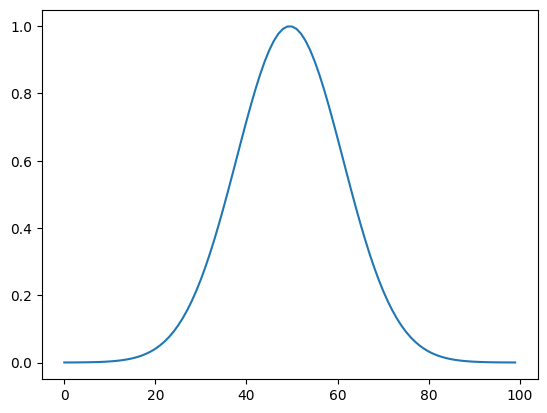
where \(a(t)\) is a Gaussian pulse. Particulary, we wish to see how the system involves in time. Let us also compare with the simulation performed by qutip.
import numpy as np
import qutip as qp
from scipy.linalg import expm
import matplotlib.pyplot as plt
X = np.array([[0, 1], [1, 0]])
Y = np.array([[0, 1j], [-1j, 0]])

print(X)
print(Y)
[[0 1]
 [1 0]]
[[ 0.+0.j  0.+1.j]
 [-0.-1.j  0.+0.j]]
Create the pulse#
t_r = np.linspace(0, 40, 100)

x = np.linspace(-3, 3, len(t_r))
pulse = np.exp(-x**2)
plt.plot(pulse)

plt.show()
Use QuTip to solve the evolution#
H_qp = [[qp.Qobj(X), pulse], [qp.Qobj(Y), pulse]]
# H_qp = qp.Qobj(X)
psi = qp.basis(2,0)
result = qp.sesolve(H_qp, psi, t_r)
Use First-order Magnus Expansion#
dt = t_r[1] - t_r[0]
dt
0.40404040404040403
psi_history = []

psi = np.array([[1], [0]])

for i in range(len(t_r)):
    Omega = dt * (pulse[i] * X + pulse[i] * Y)
    prop = expm(-1j * Omega)
    psi_history.append(psi)
    psi = prop @ psi
qp_evolution = np.array([s.full() for s in result.states])
magnus_1_evolution = np.array(psi_history)

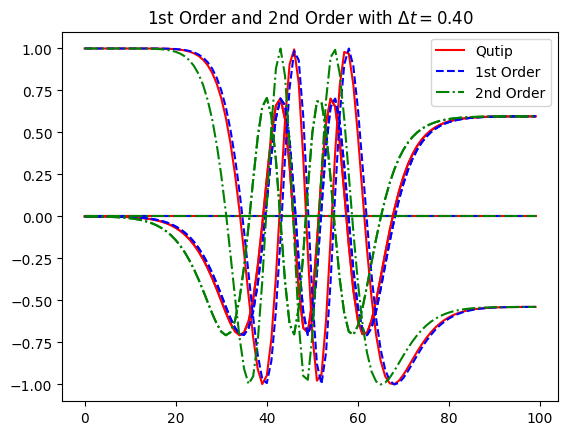
plt.plot(qp_evolution[:, 0].real, color='r', label='Qutip')
plt.plot(qp_evolution[:, 0].imag, color='r')
plt.plot(qp_evolution[:, 1].real, color='r')
plt.plot(qp_evolution[:, 1].imag, color='r')

plt.plot(magnus_1_evolution[:, 0].real, '--', color='b', label='1st Order')
plt.plot(magnus_1_evolution[:, 0].imag, '--', color='b')
plt.plot(magnus_1_evolution[:, 1].real, '--', color='b')
plt.plot(magnus_1_evolution[:, 1].imag, '--', color='b')

plt.legend()

plt.title(r"1st Order with $\Delta t = {:.2f}$".format(dt))

plt.plot();

Use two-stage Gauss quadrature for second order#
psi_history_2 = []

psi = np.array([[1], [0]])

c_1 = 0.5 - np.sqrt(3)/6
c_2 = 0.5 + np.sqrt(3)/6

def commu(A,B):
    return A@B - B@A

for i in range(len(t_r)):
    t_1 = x[i] + (c_1 * dt)
    t_2 = x[i] + c_2 * dt

    A_1 = np.exp(-t_1**2) * X + np.exp(-t_1**2) * Y
    A_2 = np.exp(-t_2**2) * X + np.exp(-t_2**2) * Y
    Omega = dt/2 * (A_1 + A_2) + np.sqrt(3)*dt**2 / 12 * commu(A_2, A_1)

    prop = expm(-1j * Omega)
    psi_history_2.append(psi)
    psi = prop @ psi
magnus_2_evolution = np.array(psi_history_2)

plt.plot(qp_evolution[:, 0].real, color='r', label='Qutip')
plt.plot(qp_evolution[:, 0].imag, color='r')
plt.plot(qp_evolution[:, 1].real, color='r')
plt.plot(qp_evolution[:, 1].imag, color='r')

plt.plot(magnus_1_evolution[:, 0].real, '--', color='b', label='1st Order')
plt.plot(magnus_1_evolution[:, 0].imag, '--', color='b')
plt.plot(magnus_1_evolution[:, 1].real, '--', color='b')
plt.plot(magnus_1_evolution[:, 1].imag, '--', color='b')

plt.plot(magnus_2_evolution[:, 0].real, '-.', color='g', label='2nd Order')
plt.plot(magnus_2_evolution[:, 0].imag, '-.', color='g')
plt.plot(magnus_2_evolution[:, 1].real, '-.', color='g')
plt.plot(magnus_2_evolution[:, 1].imag, '-.', color='g')

plt.legend()

plt.title(r"1st Order and 2nd Order with $\Delta t = {:.2f}$".format(dt))

plt.show()